Welcome to Bio Basic Asia Pacific Pte Ltd
This website uses cookies to ensure the best experience. By continuing, you agree to our Privacy Policy.


What Is DNA Sequencing? Methods, Types and How It Works
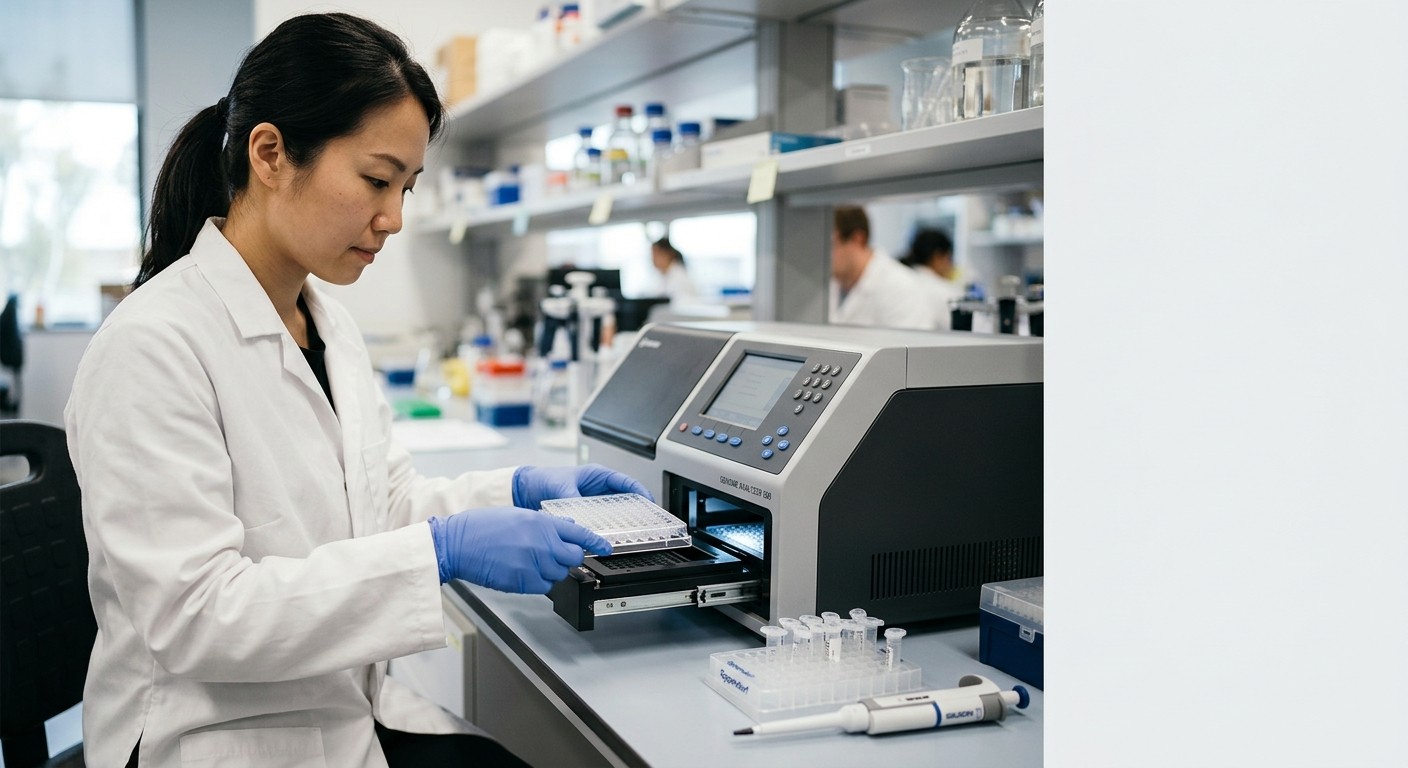
DNA sequencing is how researchers read the genetic instructions inside a living organism. It underpins everything from diagnosing an inherited disease to identifying a bacterium in a water sample to confirming that a plasmid was cloned correctly. But it is not one technique. It is a family of techniques developed across five decades, each solving a limitation of the one before it. This guide explains what the process involves, how the three generations of methods differ, and how to choose between them. If you already know which method your project needs, Bio Basic Asia Pacific offers Sanger sequencing services from its Singapore laboratory.
What is DNA sequencing?
DNA sequencing is the process of determining the exact order of the four chemical bases along a strand of DNA: adenine (A), thymine (T), cytosine (C) and guanine (G). The US National Human Genome Research Institute defines it as a method that determines the order of the four chemical building blocks that make up the DNA molecule.
That order is not arbitrary. It is the instruction set a cell reads to build proteins, and a change in a single base can alter a protein’s structure, disable it entirely, or have no effect at all. Reading the order is therefore the only way to know with certainty what a piece of DNA actually encodes.
Sequencing operates across an enormous range of scales. At one end, a researcher might read a few hundred bases to confirm that a gene was inserted into a vector in the right orientation. At the other, a project might read an entire genome. The technique used depends almost entirely on which end of that range you are working at.
How DNA sequencing works
Every sequencing method, regardless of generation, follows the same four stages.
Sample preparation and DNA extraction. DNA is isolated from cells, tissue, blood or a microbial culture and purified so that proteins, salts and other contaminants do not interfere with the chemistry that follows. Sequencing quality is limited by extraction quality, which is why this step matters more than its simplicity suggests.
Library or template preparation. The DNA is made readable by the instrument. In Sanger sequencing this means annealing a primer to a single target region. In next-generation sequencing it means fragmenting the DNA and attaching adapter sequences to millions of pieces at once, creating what is called a library.
The sequencing reaction. The instrument reads the bases. Methods differ almost entirely at this step, whether by chain termination, by detecting light as each base is added, or by measuring an electrical current as a strand passes through a pore.
Base calling and data analysis. Raw signal is converted into a sequence of letters, each with a quality score, and then aligned to a reference or assembled from scratch.
The distinction that matters when choosing a method is at stage three: how the bases are read, and how many fragments the instrument can read at the same time.
DNA sequencing vs PCR: what is the difference?
PCR amplifies. Sequencing reads. That is the whole distinction, and it is worth stating plainly because the two are frequently confused. That is understandable when they share reagents and often appear in the same protocol.
The polymerase chain reaction makes millions of copies of a DNA region whose boundaries you already know. You design primers that flank the target, and PCR produces enough material to detect, visualise on a gel or work with downstream. PCR tells you whether a sequence is present and roughly how long it is. It does not tell you what the sequence says.
DNA sequencing determines the actual order of bases in a fragment, information you did not have beforehand. It can reveal a point mutation, an insertion, a deletion, or confirm that a construct matches its design exactly.
The two are usually collaborators rather than alternatives. A typical Sanger workflow amplifies the target region by PCR first, purifies the product, and then sequences it. Cycle sequencing, the reaction at the heart of Sanger sequencing, even uses PCR-style thermal cycling. That is a large part of why the two get conflated. The difference is that cycle sequencing uses a single primer and includes chain-terminating nucleotides, so it produces a ladder of fragments of every possible length rather than millions of identical copies.
A rule of thumb: use PCR when you need more of a sequence you already know. Use sequencing when you need to find out what the sequence is.
The three types of DNA sequencing

Sequencing methods are usually grouped into three generations. Each was developed to overcome a specific limitation of the one before it: first accuracy and reliability, then scale and cost, then read length. Importantly, later generations did not replace earlier ones. All three are in routine use today, because each answers a different kind of question, and a laboratory will often use two of them on the same project.
First-generation: Sanger sequencing

Sanger sequencing, developed by Frederick Sanger in 1977, uses chain-terminating dideoxynucleotides (ddNTPs) that stop DNA synthesis when incorporated. The result is a set of fragments of every possible length, separated by size using capillary electrophoresis and read as a chromatogram. Sanger shared a quarter of the 1980 Nobel Prize in Chemistry with Walter Gilbert for this contribution to determining base sequences in nucleic acids.
It reads one target at a time, with very high per-base accuracy and long reads by first-generation standards. That combination of a single target, a long read and extremely high reliability is why it remains the reference standard for verification work rather than discovery work.
Best suited to: plasmid verification, clone confirmation, CRISPR edit validation, single-gene screening and confirming variants found by other methods. For a fuller treatment, see our guide to how Sanger sequencing works.
Second-generation: next-generation sequencing (NGS)
Next-generation sequencing reads millions of DNA fragments simultaneously rather than one at a time. DNA is fragmented, adapters are attached, and the fragments are sequenced in parallel across a flow cell, with the resulting short reads assembled computationally afterwards.
The reads are short, but the throughput is vast, which drives the cost per base down by orders of magnitude compared with Sanger sequencing. Best suited to: whole genome sequencing, whole exome sequencing, transcriptome and RNA sequencing, metagenomics, and any application where you need breadth rather than a single confirmed answer. Our article on next-generation sequencing explained covers the workflow in detail.
Third-generation: long-read sequencing
Third-generation methods read single DNA molecules directly, in real time, without an amplification step. The two dominant platforms are PacBio single-molecule real-time (SMRT) sequencing, which detects fluorescence as bases are incorporated by a polymerase held in a tiny well, and Oxford Nanopore sequencing, which the National Human Genome Research Institute describes as threading single DNA strands through extremely tiny pores in a membrane and measuring the resulting change in electrical current.
Their defining advantage is read length. Where second-generation reads are measured in hundreds of bases, third-generation reads are routinely far longer. That matters because short reads cannot span long repetitive regions. When a read cannot span a repeat, an assembly algorithm has to infer how the pieces fit together.
Long reads resolve structural variants, large insertions and deletions, repeat expansions and complex genomic regions that short-read data leaves ambiguous. They also skip the amplification step entirely, avoiding the bias PCR can introduce in GC-rich or GC-poor regions, and can detect base modifications such as methylation directly from the raw signal.
The historical trade-off was a higher per-base error rate than short-read platforms. Chemistry and base-calling improvements have narrowed that gap substantially, and long-read data is now used in applications where it once would not have been.
Best suited to: de novo genome assembly, structural variant detection, full-length transcript sequencing, and long-read metagenomics.
Sanger vs NGS: which should you use?
The choice is rarely about which method is better. It is about how many targets you have and what question you are asking.
| Sanger sequencing | Next-generation sequencing | |
|---|---|---|
| Targets per run | One | Millions, in parallel |
| Read length | Long relative to short-read NGS | Short per read |
| Cost per sample | Low for a handful of targets | Low per base, higher per run |
| Cost per base | High | Very low |
| Turnaround | Fast | Longer, driven by run time and analysis |
| Per-base accuracy | Very high | High, with depth of coverage compensating |
| Data analysis | Minimal; read the chromatogram | Substantial; requires bioinformatics |
| Best for | Verification and single targets | Discovery and breadth |
The decision in two sentences. If you have a small number of known targets and you need a definitive answer quickly, Sanger sequencing is faster, cheaper and simpler. Typical questions are whether a plasmid is correct, whether an edit took, or whether a sample carries a particular variant. If you do not yet know what you are looking for, or you need to survey an entire genome, transcriptome or microbial community, NGS is the only practical option.
The two are also complementary in practice. A common workflow uses NGS to discover candidate variants across many samples, then Sanger sequencing to confirm the handful that matter.
What DNA sequencing can tell you
Reading a DNA sequence turns a biological question into a data question, one that can be compared, stored, searched and re-analysed years later as reference databases improve. The applications fall into three broad areas, and the boundaries between them are increasingly blurred as clinical and research sequencing converge on the same platforms.
Medicine and diagnostics
Sequencing identifies the variants responsible for inherited conditions, often ending diagnostic odysseys that took years using other methods. In oncology it profiles the mutations driving a specific tumour, which increasingly informs treatment selection. In infectious disease it identifies pathogens directly from a patient sample, including organisms that are difficult or slow to culture, and tracks how they change over time. Pharmacogenomics uses sequence data to predict how an individual will metabolise a drug.
Research and evolutionary biology
Sequencing establishes what a gene does, how its expression changes under different conditions, and how it differs between individuals or species. It identifies organisms from environmental samples where culturing is impractical, and profiles entire microbial communities in soil, water or the human gut by sequencing marker genes or the whole metagenome. Comparing sequences across species reconstructs evolutionary relationships and reveals which regions have been conserved, a strong indicator that they are functionally important.
Forensics and identification
Sequence data provides a means of identification that is specific to an individual. Forensic laboratories use it to match biological evidence to a person, to identify remains where conventional methods have failed, and to establish biological relationships in paternity and immigration casework. The same principles support consumer ancestry testing and the authentication of species in food, wildlife and agricultural supply chains. It can confirm, for example, that a fish fillet is the species it is labelled as.
What affects the cost of DNA sequencing
There is no single price for DNA sequencing, because the variables that drive cost differ enormously between methods. Understanding them is more useful than any headline figure.
Number of samples. Sanger sequencing is priced per reaction, so cost scales linearly. NGS is priced per run, so the cost per sample falls sharply as you add samples to a flow cell. One sample on an NGS run is expensive; ninety-six is not.
Read length required. Longer reads and larger target regions cost more. Sequencing a full construct may require primer walking across multiple overlapping reactions rather than a single read.
Depth of coverage. NGS projects specify how many times each base should be read. Detecting a rare variant in a mixed sample requires far deeper coverage, and therefore more sequencing, than confirming a germline variant.
Sample condition and purification. Impure or degraded samples may need additional purification before they can be sequenced, and poor-quality input is a common cause of failed reactions and repeat costs.
Turnaround. Expedited processing typically carries a premium.
Data analysis scope. Raw reads are not an answer. Alignment, variant calling, assembly and interpretation are separate work, and on large projects the analysis can cost as much as the sequencing.
Because these variables interact, the practical approach is to describe your project and have it scoped rather than comparing list prices. Include the sample type, the number of samples, the target size and what you need to determine.
DNA sequencing services in Singapore
Bio Basic Asia Pacific provides both Sanger and next-generation sequencing from its Singapore laboratory, which means researchers here can access either method without shipping samples offshore.
Standard Sanger sequencing is returned within 24 hours of sample receipt on a normal working day, with read lengths of 800 to 1000 base pairs. The service includes access to over 100 free universal primers, free gel analysis, and one free re-sequencing run on request.
For projects that need breadth rather than verification, the next-generation sequencing services cover whole genome sequencing, whole exome sequencing, amplicon and metagenomic sequencing, RNA sequencing and long-read applications.
If you are not certain which method your project requires, describing the sample type, sample count and the question you need answered is usually enough for our team to recommend an approach. Request a quote for DNA sequencing and we will scope it with you.
Frequently asked questions
What is the DNA sequencing process?
DNA sequencing follows four stages: extracting and purifying DNA from the sample; preparing it for the instrument, either by annealing a primer to a single target or by building a fragment library; running the sequencing reaction itself, which reads the bases; and converting the raw signal into a sequence of letters that is then aligned or assembled. The middle two stages are where the methods differ. Everything else is broadly common across them.
What can DNA sequencing tell you?
Sequencing reveals the exact order of bases in a DNA fragment, which makes it possible to identify mutations and variants, confirm that a genetic construct matches its design, identify organisms from a biological sample, measure which genes are being expressed, and reconstruct evolutionary relationships between species. What it cannot do on its own is tell you what a sequence means. Interpretation requires comparison against reference data and biological context.
What are the three types of DNA sequencing?
The three generations are first-generation Sanger sequencing, which reads one target at a time with long, highly accurate reads; second-generation next-generation sequencing (NGS), which reads millions of short fragments in parallel at very low cost per base; and third-generation long-read sequencing on PacBio and Oxford Nanopore platforms, which reads single molecules without amplification and produces much longer reads.
What is the difference between PCR and DNA sequencing?
PCR amplifies a DNA region whose boundaries you already know, producing many copies of it. DNA sequencing determines the actual order of bases in a fragment, which is information you did not have beforehand. They are usually used together rather than as alternatives, because PCR often prepares the material that is then sequenced. Use PCR when you need more of a known sequence, and sequencing when you need to find out what the sequence is.
Is DNA sequencing good or bad?
DNA sequencing is a measurement technique, and its value depends on how the resulting data is used. Its benefits are substantial and well established: faster diagnosis of inherited disease, better-targeted cancer treatment, rapid pathogen identification, and a great deal of fundamental biological research. It also raises genuine considerations. Genetic data is uniquely identifying and cannot be anonymised in the way most personal data can, which makes storage, consent and access policy important. Results also require careful interpretation. A variant of uncertain significance is a common outcome, and a raw sequence on its own does not constitute a diagnosis.
Resources
-
National Human Genome Research Institute: DNA Sequencing Fact Sheet
https://www.genome.gov/about-genomics/fact-sheets/DNA-Sequencing-Fact-Sheet
Checked 21 August 2026. Supports the definition of DNA sequencing and the description of nanopore sequencing. -
The Nobel Prize: The Nobel Prize in Chemistry 1980
https://www.nobelprize.org/prizes/chemistry/1980/summary/
Checked 21 August 2026. Supports the statement that Frederick Sanger shared a quarter of the 1980 Nobel Prize in Chemistry with Walter Gilbert for contributions concerning the determination of base sequences in nucleic acids.
